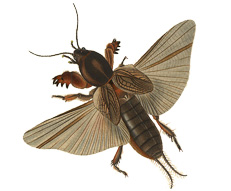
Mole Cricket.
Though usually considered turfgrass pests, mole crickets have a broad diet. The southern mole cricket feeds mainly on other insects, and the tawny and short winged mole crickets feed on plants. The tawny mole cricket often injures bahia grass and Bermuda grass, and the short-winged mole cricket often attacks St. Augustine grass and Bermuda grass.
Latin Name
Scapteriscus spp
Appearance
Southern mole crickets have long hind wings that extend past the abdomen and are rounded at the tips. Adults are brownish-gray with a dark pronotum. The dactyl spacing is similar for short-winged mole crickets (looks like a “U”), so these two species can best be distinguished by wing length. The southern mole cricket’s calling song occurs during the first two hours after sunset.
Habitat
Mole crickets can damage plants by feeding at night on aboveground foliage or stem tissue and belowground on roots and tubers. Seedlings may be girdled at the stems near the soil surface, though some plants may be completely severed and pulled into a tunnel to be eaten. Mole cricket tunneling near the soil surface dislodges plants or causes them to dry out. Small mounds of soil are also pushed up. Tunneling reduces the aesthetic quality of turfgrass, interferes with the roll of the ball on golf courses, and results in reduced livestock grazing on severely infested pastures.