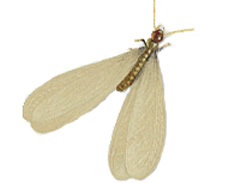
Drywood Termites.
Drywood termites, like all termites, are eusocial insects. They live in colonies and cooperatively care for young. Responsibilities for reproduction, foraging and colony defense are divided up among castes: reproductives (king, queen and alates), workers and soldiers. In drywood termites, the “worker” caste does not consist of true workers that are reproductively sterile and found in the higher termites of the family Termitidae. Rather, immature termites do the labor of the traditional worker caste, and they are known as pseudergates (“false workers”).
Latin Name
Cryptotermes cavifrons
Appearance
All the castes have chewing mouthparts, although the mandibles of the soldiers are greatly modified for defense to the point that they must be fed by the pseudergates. All but the reproductives are blind. Because termite workers are indistinguishable from each other to the level of species, most termite keys rely on characteristics of soldiers and alates (winged, unmated reproductives) for species identification.
Habitat
Sometimes called powderpost termites because of the telltale heaps of fecal pellets (frass) that accumulate beneath infested wood. The most economically significant termite in this genus, Cryptotermes brevis (Walker), commonly infests structures and was at one time known as the “furniture termite,” thanks to the frequency with which colonies were found in pieces of furniture